Google and AI visibility
How to get ChatGPT, Gemini and Google to recommend your company
More and more people ask an AI assistant before searching on Google. Here is what your website needs to show up in those answers.
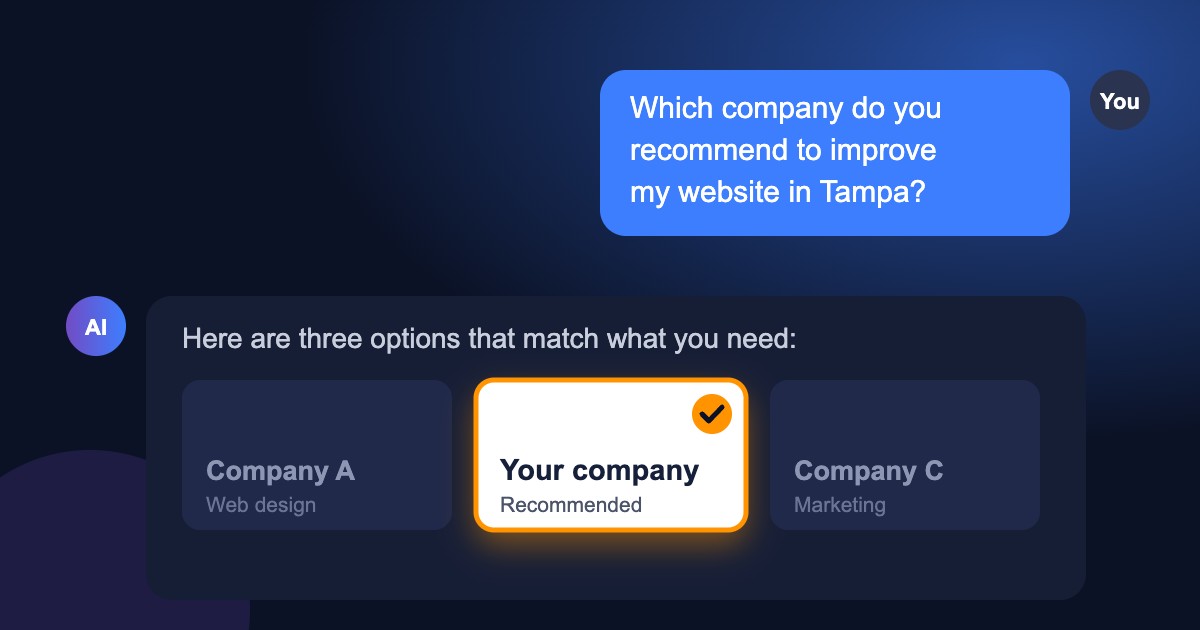
Until recently, searching online meant typing a few words into Google and scanning a list of links. Today many people ask ChatGPT, Gemini or Perplexity a full question, and Google itself answers with an AI-generated summary before showing the results.
Those answers usually mention only a few companies. If yours is not one of them, for that customer it simply does not exist. The good news is that AI does not choose at random: it relies on information it can read, understand and verify. And that is something you can work on.
Key takeaways
- AI recommends companies whose information is clear, consistent and verifiable.
- Your website must let AI crawlers read it and answer your customers’ real questions.
- The foundations are the same as good SEO: AI search does not replace it, it extends it.
How an AI decides which companies to mention
When someone asks “which company do you recommend for…?”, the AI builds its answer from what it finds published on the topic. In practice, it looks at four things:
- What it can read: your website, your Google profile, directories, reviews and articles that mention you.
- What is clear: what you do, for whom and where, in plain words.
- What is consistent: the same name, address, phone number and services on every channel.
- What it can confirm: information that matches across several sources carries more weight than an isolated claim.
Seven adjustments that make the difference
Let AI crawlers read your site
Many websites unknowingly block the ChatGPT, Gemini or Perplexity crawlers in a technical file called robots.txt. If they cannot get in, they cannot recommend you.
Explain what you do in one sentence
On your homepage, in real text (not inside an image): what you offer, to whom and in which city or country.
One page per service, with questions answered
People ask AI full questions. If your website answers those same questions in natural language, you have a better chance of appearing in the answer.
Add structured data
These are tags visitors never see that tell Google and AI who you are, what you offer, where you are and how to contact you.
Complete your Google Business Profile
For local searches it is one of the main sources: categories, hours, services, photos and up-to-date reviews.
Keep your details identical everywhere
The same name, address and phone number on your site, Google, social media and directories. Differences create doubt.
Show verifiable proof
Case studies, numbers and real clients. It is easier to recommend a company that shows what it does. See how we do it on our results page.
One extra step: the llms.txt file is a summary of your website written for AI. It is still a new practice and guarantees nothing, but it takes little time and helps AI understand your business.
What does not work
- Repeating keywords without adding useful information.
- Publishing generic, mass-produced content with no real data about your company.
- Promising results you cannot prove.
How to check whether you already appear
Test it yourself: in a private window, ask ChatGPT, Gemini and Perplexity what your customer would ask, for example “which office furniture company do you recommend in Tampa?”. Note whether they mention you and what they say.
Complement this with Google Search Console, which shows the searches that already bring you visits. Repeat the exercise every month to track progress.
In short
AI search does not replace SEO: it extends it. The same fundamentals as always, a clear, fast website with verifiable information, are what make an AI recommend your company today. At JAVIBOT we apply these adjustments as part of the system we run for every client.
Want to apply this to your company?
In a free 30-minute assessment we review your case and tell you where to start.