Customer service
The customer who messaged and got no reply
You pay for an ad, someone interested writes to you, and the reply arrives hours later. This is how you lose customers who were ready to buy, and how to avoid it.
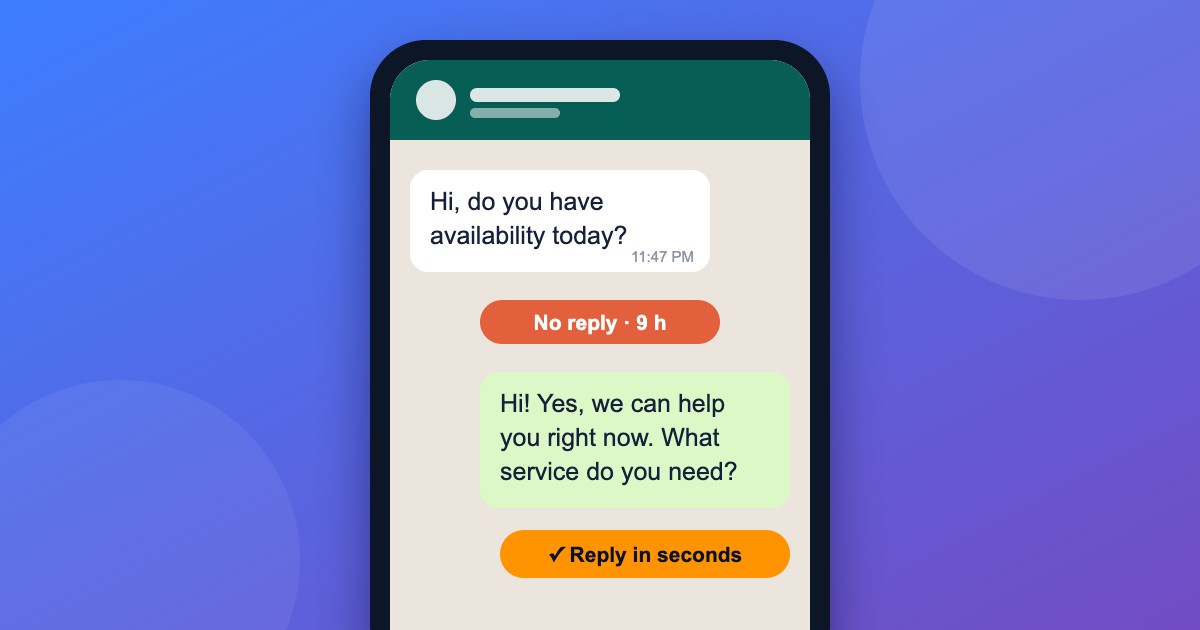
Picture this: you invest in an ad, someone sees it, likes it and messages you on WhatsApp at nine at night. Your team sees it the next morning. By then, that person has already written to two other companies, and one of them replied first.
It is not a lack of commitment from your team: nobody can watch their phone all day. But the result is the same. You paid to attract a customer, and they left without anyone helping them.
Key takeaways
- Response speed matters as much as the ad that brought the customer in.
- Messages at night and on weekends are the ones most often lost.
- Well-configured automated service replies instantly, handles the basics and passes to a person whatever needs one.
Where the customer gets lost
In many companies, customers are not lost because of price or product, but at these moments:
- Messages outside business hours: nights, weekends and holidays, exactly when many people have time to search.
- Replies that solve nothing: a “we will be right with you” that never gets to the information the person asked for.
- Disconnected channels: WhatsApp, Instagram, the website form and phone calls, each on its own.
- No follow-up: nobody writes back to the person who asked and did not buy.
How to estimate what you are missing
Count the messages
Check how many messages you received last month on each channel: WhatsApp, social media, the form and phone calls.
Spot the ones that waited
Flag those that arrived outside business hours or waited more than an hour for a reply.
Put a value on it
Multiply those messages by your usual close rate and by the average value of a customer.
It does not need to be exact. This estimate helps you size the problem and decide how much solving it is worth.
What good automated service does
- Replies instantly, at any hour, on WhatsApp, your website and social media.
- Answers with your business’s real information: services, hours, coverage and frequently asked questions.
- Asks the key questions to understand what the person needs.
- Books an appointment or hands the conversation to someone on your team when needed.
- Keeps a record of every contact for follow-up.
AI is the tool, not the goal. What matters is that every person who writes to you gets a useful reply in time.
What you should not automate
Negotiations, complaints and sensitive cases should reach a person. And an assistant that cannot answer and sends the customer in circles is never a good idea: it is worse than having none. Automation works when it knows its limits and hands off the conversation in time.
In short
Getting a customer to message you costs time and money; leaving them without a reply wastes that investment. At JAVIBOT we set up automated service connected to your advertising and your website, so no customer slips away.
Want to apply this to your company?
In a free 30-minute assessment we review your case and tell you where to start.